
Lip fungal infection is an everyday term for a Candida infection inside the mouth or at the corners of the lips. White patches, redness, burning and cracking at the corner of the lip can occur. However, not every white spot or sore on the lip is fungal.
For an oral fungal infection to clear, the right diagnosis comes first. A clinician can plan antifungal treatment according to the site and severity of the infection. Oral care and correcting risk factors support treatment, but do not replace prescribed medication.
What Are Oral Thrush and Lip Fungal Infection?
Oral thrush is an infection that develops when Candida yeasts multiply more than usual in the lining of the mouth. It is also called oral candidiasis. Candida can be present in the mouth without causing symptoms. Infection can appear when the balance in the mouth is disturbed.
Medically, "lip fungal infection" is not the name of a single disease. The term can describe Candida patches inside the lip or cracks linked to infection at the corner of the lip. Involvement of the lip corner is called angular cheilitis.
Herpes labialis, which means a cold sore, is a different infection. A cold sore is caused by a virus and usually starts with clustered, fluid-filled blisters.
What Are the Signs of a Lip Fungal Infection?
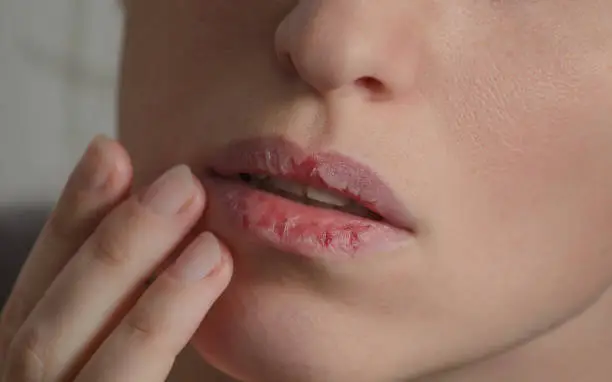
The appearance can vary depending on whether the infection is inside the mouth or at the corner of the lip. Symptoms alone do not give a diagnosis.
- Cream-colored white patches on the tongue, inner cheek or palate
- A red, tender surface under the patches that bleeds easily
- Burning, pain or a cottony feeling in the mouth
- Reduced taste or an unpleasant taste
- Discomfort while eating and drinking
- Redness, cracking and crusting at the corners of the lips
- Redness, tenderness or burning under a denture
The white patches of oral thrush can sometimes be wiped away gently. However, scraping the lesions at home can cause bleeding and irritation.
Is a White Spot or Patch on the Lip Always Fungal?
There are many causes of white spots on the lips. Small white spots on the upper or lower lip can be Fordyce spots, which are normal oil glands. Lip eczema, canker sores, cold sores and persistent oral lesions can also be mistaken for a fungal infection.
| Possible condition | Typical appearance | Distinguishing feature |
|---|---|---|
| Oral thrush | Cream-colored white patches or red areas | Can cause burning; a tender surface may remain when wiped |
| Angular cheilitis | Cracking, redness and crusting at the lip corner | Can be linked to fungi, bacteria or constant contact with saliva |
| Canker sore | A round ulcer with a white or yellow center and red border | Usually painful and not a fungal infection |
| Fordyce spots | Many small, yellowish or white spots | Mostly painless and a harmless anatomical feature |
| Lip eczema | Dryness, flaking, redness and burning | Can worsen with lip licking, cosmetics or irritation |
| Cold sore | Clustered blisters and crusting after tingling | Caused by a virus; different from oral thrush |
| Persistent white lesion | A thick or irregular white area that cannot be wiped off | If it lasts longer than two weeks, a dentist should assess it |
The whole lip suddenly turning pale is also not a typical sign of a fungal infection. Recurrent paleness of the lips should be assessed for underlying medical causes.
What Causes a Lip Fungal Infection?
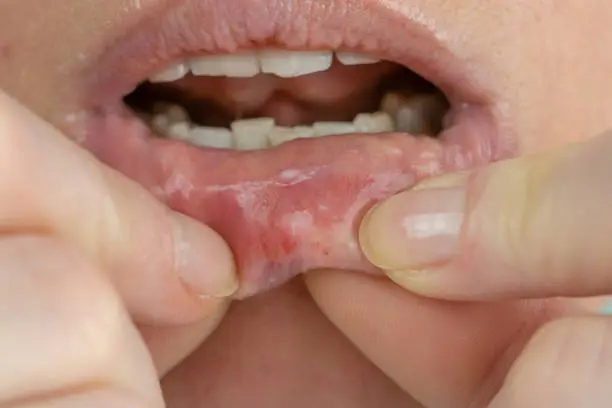
Candida overgrowth usually has more than one cause. Factors affecting the oral environment, the amount of saliva or the immune response can act together.
- Prescribed antibiotics changing the oral flora
- Conditions or treatments that suppress the immune system
- Diabetes with inadequate blood sugar control
- Dry mouth and reduced saliva flow
- Not rinsing the mouth after an inhaled corticosteroid
- Removable dentures not being cleaned properly or not removed at night
- Poorly fitting dentures constantly irritating the oral tissue
- Smoking
- Vulnerable periods such as older age or infancy
- Inadequate oral and denture care
Oral thrush recurring in otherwise healthy adults can point to a risk factor that needs assessment. Diabetes, dry mouth and current medicines are reviewed in this respect.
Why Does a Fungal Infection Develop at the Corner of the Lip?
Saliva collecting at the corner of the lip can weaken the skin barrier. Deep lip folds, a poorly fitting denture and a habit of licking the lips can keep the area constantly moist.
Bacteria can be present alongside Candida in this area. So applying an antifungal product to every sore at the corner of the lip is not appropriate. Irritation, eczema and nutritional deficiencies can also be investigated.
How Are Lip and Oral Fungal Infections Diagnosed?
The diagnosis is usually made from an oral examination, the symptoms and the medical history. The dentist assesses where the lesion is, whether it can be wiped off, denture use and dry mouth.
If the appearance is not typical, or the problem keeps coming back, a sample can be taken from the lesion. Where needed, blood sugar, nutritional deficiencies or conditions affecting immunity are investigated.
White lesions that cannot be wiped off, become hard or last longer than two weeks should not be assumed to be fungal. If the dentist considers it necessary, they can refer you for further investigation or a biopsy.
At our clinic we often see cracks at the corner of the lip assumed to be fungal alone. At the examination, irritation, denture fit and dry mouth are assessed together.
How Do Lip and Oral Fungal Infections Clear Up?
Treatment is planned according to the site and severity of the infection. Antifungal medicines applied in the mouth or acting systemically may be needed. The choice of medicine and how long it is used should be set on prescription.
Other medicines you take, pregnancy, age and chronic conditions can affect the choice of treatment. So restarting a medicine you used before may not be safe.
For sores at the corner of the lip, targeting fungi alone may not be enough. If there is a bacterial infection, eczema or mechanical irritation, a separate approach is needed for those.
Products containing antibiotics or corticosteroids should not be used without clinical advice. These products can change the appearance and delay the correct diagnosis.
Measures That Support Treatment
- Cleaning removable dentures every day with suitable products
- Taking dentures out at night to rest the oral tissues
- Having poorly fitting dentures checked by a dentist
- Assessing the factors that can cause dry mouth
- Keeping up blood sugar monitoring if you have diabetes
- Rinsing the mouth with water after inhaled medicines
What Helps Oral Thrush?
Home care can reduce discomfort in the oral tissue and lower the risk of recurrence. Even so, you should not rely on home measures alone during an active infection.
- Clean your teeth twice a day with a soft-bristled brush.
- Clean your tongue gently, without irritating it.
- Drink enough water and discuss dry mouth with your dentist.
- If very hot, spicy or acidic foods cause pain, limit them.
- Stay away from smoking and other tobacco products.
- Avoid the habit of licking your lips.
- Pause cosmetics that irritate the corner of the lip.
- Clean your dentures regularly with suitable, non-abrasive cleaners.
There is not enough clinical evidence that methods such as baking soda, vinegar or garlic clear oral thrush. Concentrated or direct use can irritate the oral tissue.
Why Does Oral Thrush Keep Coming Back?
With thrush that does not clear, the accuracy of the diagnosis is assessed first. Conditions such as lip eczema, leukoplakia and denture-related irritation may have been mistaken for a fungal infection.
Possible reasons for an infection that recurs or does not respond to treatment include:
- An underlying risk factor still being present
- A microbial layer on the denture surface
- Marked dry mouth
- Uncontrolled diabetes
- A condition or treatment affecting the immune system
- A drug interaction or treatment not being used correctly
- A less susceptible Candida species being involved
- The original diagnosis not being a fungal infection at all
In that case, rather than repeating the same product without supervision, an examination by a dentist or doctor is needed. Culture and further tests can help identify the reason for the recurrence.
How Many Days Does Oral Thrush Take to Clear?
There is no fixed healing time that applies to everyone with oral thrush. After suitable treatment, symptoms can start to ease within the first week. Full recovery time depends on how widespread the infection is and on the person's health.
If there is no clear improvement despite prescribed treatment, another examination is needed. Frequently recurring symptoms also call for investigation of the underlying causes.
When Should You See a Dentist or Doctor?
If white patches in the mouth appear for the first time, or the cause is unknown, book an examination. Recurrent thrush in adults in particular should be assessed.
- If a white or red lesion lasts longer than two weeks
- If the lesion cannot be wiped off, becomes hard or grows
- If there is difficulty swallowing, pain on swallowing or a feeling of something stuck in the throat
- If food and fluid intake has dropped noticeably
- If there is unexplained bleeding or a lump in the mouth
- If the immune system is suppressed
- If infections keep recurring alongside diabetes
- If complaints increase despite treatment
Difficulty breathing, or rapidly developing swelling of the face or lips, needs urgent assessment. These are not typical findings of oral thrush.
How Can Oral and Lip Fungal Infections Be Prevented?
It is not always possible to prevent oral thrush. However, improving the oral environment and denture hygiene can reduce some risks.
- Clean your teeth and tongue regularly, using a gentle technique.
- Clean removable dentures daily and do not leave them in at night.
- Have a dental check-up if a denture rubs or becomes loose.
- Rinse your mouth with water after using an inhaled corticosteroid.
- Use antibiotics only on prescription.
- If dry mouth continues, ask for the cause to be assessed.
- Keep up regular monitoring of diabetes and other chronic conditions.
- Do not use smoking or other tobacco products.
Frequently Asked Questions
How does a lip fungal infection clear up?
First it should be confirmed whether it is a fungal infection. A clinician can plan prescribed antifungal treatment according to the site and severity of the infection.
What helps oral thrush?
Regular oral and denture hygiene, drinking enough water and rinsing the mouth after inhalers support treatment. Home measures do not replace prescribed treatment.
How many days does oral thrush take to clear?
There is no fixed healing time. Symptoms can ease within the first week after suitable treatment; the full timescale varies with the person's health.
Why does oral thrush keep coming back?
A wrong diagnosis, dry mouth, denture hygiene, diabetes or conditions affecting immunity can play a part. In recurrent cases, a repeat examination and, if needed, a culture are carried out.
What causes white spots on the lips?
Besides fungal infection, Fordyce spots, canker sores, eczema, cold sores and persistent oral lesions can create a white appearance. Spots that cannot be wiped off or last longer than two weeks should be assessed.
Can you get a fungal infection at the corner of the lip?
Yes, Candida can accompany cracks at the corner of the lip. However, angular cheilitis can also be linked to bacteria, eczema, saliva contact or a poorly fitting denture.
Is a lip fungal infection contagious?
In adults, oral thrush is generally not considered contagious. The infection mostly appears when the balance of a person's own oral flora is disturbed.
How can lip eczema be told apart from a fungal infection?
Eczema typically shows widespread dryness, flaking and irritation that worsens with products. A fungal infection can cause white patches inside the mouth or cracks at the lip corner; the distinction is made by examination.