
Dental floss is a thin, flexible oral care tool used to clean the spaces between the teeth and the gum line, where a toothbrush cannot reach well. Along with food debris, it helps mechanically remove the bacterial plaque that clings to the tooth surface.
Cleaning between the teeth every day complements brushing and supports gum health. The general recommendation is to use dental floss, or another suitable interdental cleaner, once a day.
What Does Dental Floss Do?
Toothbrush bristles cannot fully reach the contact surfaces between teeth that touch each other. Floss is passed through these narrow spaces and lifts plaque and trapped food off the surface.
Regular and correct flossing contributes to oral care in the following ways:
- It helps remove plaque and food debris from between the teeth.
- It may help reduce the risk of gum redness, swelling and bleeding.
- It supports daily oral care against decay on the contact surfaces.
- It may help reduce bad breath linked to food and plaque build-up.
- It helps limit the plaque build-up that can turn into tartar.
Floss is not a whitening method. Removing surface deposits can make the teeth look cleaner, but it does not lighten the tooth color.
The certainty of the evidence on interdental cleaning may be low or very low. Even so, established oral care guidance supports cleaning between the teeth every day.
Should You Floss Every Day, and How Many Times?
As a general rule, floss every day and once a day. Flossing several times a day is not necessary for most people. What matters is doing it regularly and with the correct technique.
The evening can be practical, because it removes the plaque that has built up during the day. However, you can also choose another time that you are able to keep up.
- Frequency: Clean between your teeth once a day.
- Timing: Pick a time that fits your daily routine.
- Extra use: If food gets stuck, you can gently clean the area with a fresh piece of floss.
- Reuse: Do not wash and reuse a used piece of floss.
If food keeps getting trapped in the same spot, floss alone may not be enough. A filling, decay or the way your teeth meet should be assessed by a dentist.
How to Use Dental Floss
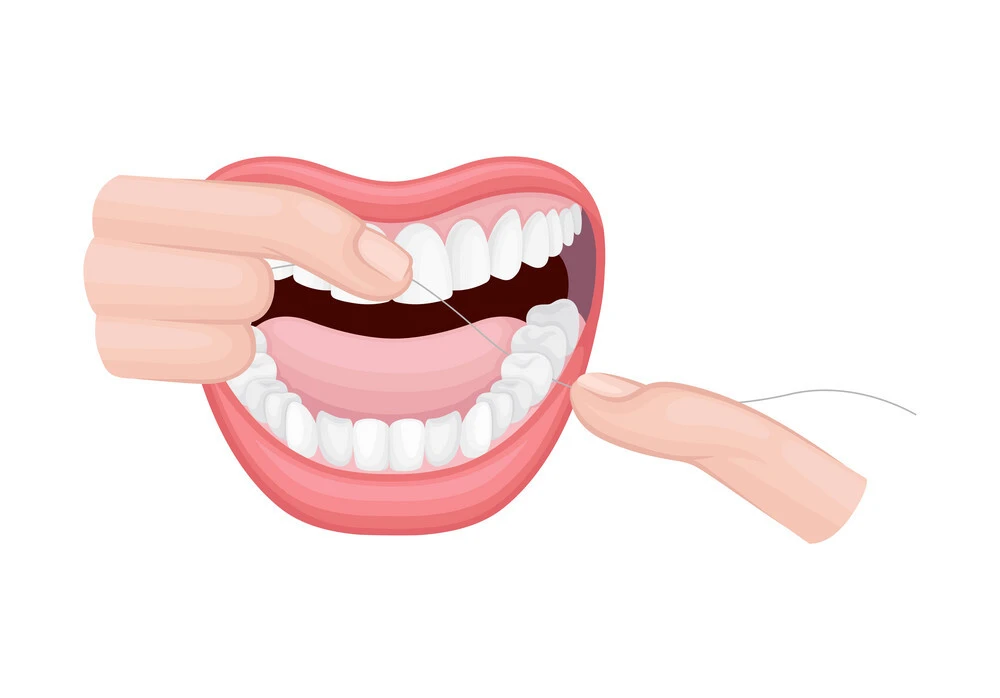
The benefit of floss depends on your technique as much as on the material. Snapping the floss down onto the gum does not improve cleaning and can injure the tissue.
- Cut a piece of floss about 40–45 centimeters long.
- Wind most of the floss around the middle fingers of both hands.
- Leave a taut section of 3–5 centimeters between your thumbs and index fingers.
- Guide the floss through the contact point with a slow back-and-forth motion.
- Curve the floss against the side surface of one tooth to form a C shape.
- Move gently to just below the gum line and slide the floss up and down.
- Clean the other tooth surface in the same gap separately.
- Use a clean section of floss for each gap.
- Also clean the outward-facing surfaces of the rearmost teeth.
- Throw the used floss away when you are finished.
Do not apply pressure as you move below the gum line. The aim is to scrape the side surface of the tooth, not to cut the gum.
Common Flossing Mistakes
- Forcing the floss between the teeth with a sudden movement.
- Only removing the food and not cleaning the side surface of the tooth.
- Rubbing the floss against the gum with a back-and-forth sawing motion.
- Using the same soiled section of floss in every gap.
- Stopping oral care entirely when bleeding appears, without looking into the cause.
- Pulling the floss out hard when it catches on a filling or crown.
One mistake we often see at our clinic is passing the floss through the contact point without control. Moving slowly reduces the risk of injuring the gum.
Should You Floss Before or After Brushing?
You can floss before or after brushing. When the cleaning is done carefully, both orders are acceptable.
Flossing first loosens the deposits between the teeth. You can then brush with a fluoride toothpaste. The key point is not to skip interdental cleaning in your daily routine.
Mouthwash does not replace the mechanical cleaning that floss provides. If you plan to use a mouthwash, you can ask a dentist whether you need one and when to use it.
What Types of Dental Floss Are There?

Dental floss is mostly made from nylon fibers or single plastic filaments. Waxed, unwaxed, tape-shaped, flavored and special-purpose options are available.
| Type of Floss | Main Feature | Where It Is Used |
|---|---|---|
| Nylon floss | Made of several thin fibers. Available in waxed and unwaxed versions. | Can be considered for daily use in standard tooth gaps. |
| PTFE floss | Usually a single filament with a slippery surface. Passes easily through contact points. | Worth considering if floss shreds or breaks in tight gaps. |
| Dental tape | Wider and flatter than classic floss. | May be preferred by people who want a broader contact surface. |
| Floss pick | The floss is fixed onto a small handle. | Can make flossing easier for people with limited manual dexterity. |
| Stiff-ended special floss | Has a tip that can be threaded under a bridge or an orthodontic wire. | Can be used around bridges, implant-supported work or braces on a dentist's advice. |
| Flavored or coated floss | May contain mint flavor or different surface coatings. | Can be chosen for comfort; it does not replace correct technique. |
What Is PTFE Dental Floss?
PTFE is a plastic-based material called polytetrafluoroethylene. PTFE flosses usually have a single-filament structure and can slide more comfortably through tight contact points.
Choosing PTFE or nylon floss does not by itself determine the outcome of your oral care. What matters is choosing a product you can use comfortably and with the correct technique.
What Is the Difference Between Waxed, Unwaxed and Fluoride Floss?
Waxed floss can be more slippery and may pass more easily between the teeth. No clear advantage in plaque removal has been shown between waxed and unwaxed options.
Floss containing fluoride or other active ingredients is also available. Strong evidence for the extra clinical benefit of these additives is limited. These products do not replace fluoride toothpaste.
Is Bleeding While Flossing Normal?
Bleeding during flossing can be caused by gum inflammation or by using the floss too forcefully. Sensitivity is common in people who have just started cleaning between their teeth.
Do not press the floss into the gum, and clean the tooth surface with gentle movements. If bleeding recurs, increases or comes with swelling, a dentist should assess it.
Giving up interdental care indefinitely because of bleeding allows plaque to keep building up. Even so, do not force a painful area, and learn the correct technique from your dentist.
Is Flossing Harmful?
Used correctly, dental floss is generally a safe oral care tool. Poor technique, however, can cause cuts, irritation, pain or bleeding in the gum.
If the floss keeps catching on a filling, a crown or a rough part of a tooth, do not pull it up hard. Where possible, remove it sideways and show the area to your dentist.
Applying excessive force or rubbing the same area for a long time does not clean better. Floss should be used with gentle, controlled and short movements.
Does Flossing Get Rid of Bad Breath?
By removing food and plaque left between the teeth, floss may help reduce bad breath. However, interdental build-up is not the cause of every case of bad breath.
Gum disease, decay, dry mouth, coating on the tongue or other health problems can also cause odor. Bad breath that persists despite regular care should be assessed.
Can You Floss With Braces, a Bridge or an Implant?
Fixed braces, bridges and implant-supported restorations can make interdental cleaning harder. In these cases, special cleaning tools may be needed alongside classic floss.
- Braces: A floss threader, stiff-ended special floss or a correctly sized interdental brush can be used.
- Bridge: The area under the bridge body can be cleaned with special floss threaded into that space.
- Implant: Floss suitable for implants or a coated interdental brush may be preferred.
- Wide gaps: An interdental brush can be easier to use than classic floss.
An interdental brush of the wrong size, or uncontrolled flossing, can irritate the tissue. The tool should be chosen to suit the shape of your mouth.
What Can You Use Instead of Dental Floss?
Floss is not the only option for cleaning between the teeth. The width of your gaps, the condition of your gums and your manual dexterity all affect which tool to use.
- Interdental brush: Can be used for wide gaps, in people with gum disease or during orthodontic treatment.
- Water flosser: Devices that work with pressurized water can be considered for people who struggle with classic floss.
- Floss holder: Can make it easier to reach the back teeth.
- Floss threader: Helps guide floss under a bridge or an orthodontic wire.
A toothpick used without control can injure the gum, and it does not replace floss. Mouthwash does not mechanically scrape plaque off the tooth surface either.
When Should You See a Dentist?
Short-lived sensitivity can occur while flossing. If you have any of the following signs, an oral and dental examination should be planned:
- Recurring or ongoing gum bleeding
- Redness, noticeable swelling or pain in the gums
- Gum recession or loose teeth
- Discharge of pus, a bad taste or persistent bad breath
- Food constantly getting trapped in the same gap
- Floss that repeatedly catches, breaks or shreds at the same spot
- Plaque and tartar build-up that does not decrease despite oral care
If there is rapidly increasing facial swelling, fever, or difficulty swallowing or breathing, seek medical care without delay.
How to Complete Your Daily Oral Care
Floss alone does not cover your whole oral care routine. A daily plan should include brushing, interdental cleaning and the necessary check-ups together.
- Brush your teeth twice a day for about two minutes with a fluoride toothpaste.
- Clean between your teeth once a day with a suitable tool.
- Clean the surface of your tongue without applying heavy pressure.
- Limit how often you consume sugary foods and drinks.
- Agree on your check-up interval with your dentist, based on your oral health.
If you find flossing difficult, get technical support instead of changing tools at random. A short hands-on demonstration can make daily cleaning more controlled.
Frequently Asked Questions
What is dental floss and what does it do?
Dental floss removes plaque and food debris from the contact surfaces a toothbrush cannot reach. It complements brushing and helps protect tooth and gum health.
Should you floss every day?
The general recommendation is to use floss, or another suitable interdental cleaner, every day. Regular use matters more than occasional, forceful cleaning.
How many times a day should you floss?
Once a day is enough for most people. If food gets trapped, you can do extra cleaning with a fresh piece of floss.
When should you floss?
Flossing in the evening can be practical, but there is no required time for everyone. You can choose a time you are able to keep up daily.
Should you floss before or after brushing?
Both orders are acceptable. Flossing first can loosen the deposits between the teeth and make them easier to remove afterwards.
What is PTFE dental floss?
PTFE floss is a plastic-based product, usually made of a single filament. Because it is slippery, it can pass more comfortably through tight gaps.
Does flossing get rid of bad breath?
It may help reduce odor caused by food and plaque build-up. Bad breath that persists despite regular care needs a dentist's assessment.
How much does dental floss cost?
The retail price depends on the material, the length, the number of items in the pack and whether it comes on a holder. When choosing, look beyond price at whether you can use the product comfortably and regularly.